WARNING: This is a very raw draft that has undergone much cut and pasting and awaits final editing including grammar checks.
"I propose, with the help of this
Congress and of the American people, that hereafter there shall not be any disregard of that essential guarantee of
your Constitution (Art. IV, Sec. II) in any State of the Union. And how? By simply adding an amendment to the
Constitution to operate on all the States of this Union alike, giving to Congress the power to pass all laws necessary
and proper to secure to all persons"which includes every citizen of every State"their equal personal rights; and if the tribunals of South Carolina will not respect the rights of the citizens of
Massachusetts under the Constitution of their common country, I desire to see the Federal judiciary clothed with
the power to take cognizance of the question, and assert those rights by solemn judgment, inflicting upon the offenders
such penalties as will compel a decent respect for this guarantee to all the citizens of every State ... Well might the
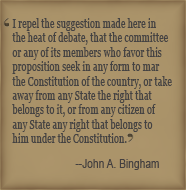
President demand, as he does demand in his message, 'equal and exact justice to all men.' That is precisely what is proposed to be accomplished." --Rep. John Bingham (Cong. Globe, 39th, 1st Sess., 158 (1866))
To understand the goal and function of the Fourteenth Amendment's first section one needs to understand that its
entire purpose was to give legal validity to the Civil Rights Bill of 1866. The goal of both of these acts were to put
an end to criminal black codes established under former rebel States that at the time were being administered under
policies of President Andrew Johnson.
Because former slaves were now considered citizens of the United States by Lincoln's emancipation, Congress
felt it was vital to protect their fundamental rights as United States citizens under Article IV, Sec. II of the U.S.
Constitution wherever they traveled within the Union (especially in the South and Oregon). These fundamental rights of
United States citizens (not citizens residing within their own State) were universally understood to include protection of due
process in criminal proceedings and access to courts to enforce contrats, sue, etc. This is why black codes were
found objectionable; they placed the black man on unequal footing in criminal proceedings with the white man.
Under the original Constitution, citizens of the United States were required to be first a citizen of some State -
something blacks of the south could not claim. This is why it was imperative for the first section to begin with
a definition of citizenship so that no State could refuse recognition of newly freed slaves as U.S. citizens and
thereby leaving them with less protection and remedies under State laws of justice compared with a white
citizen.
It should be pointed out that after the south surrendered there was no longer any organized Southern States
belonging to the Union, only federally administered former States that became divided into military districts whose
inhabitants were treated primarily as citizens of the United States rather than citizens of a State. The problem with
the initial administration of these former rebel States was with President Andrew Johnson's lack of consultation with
Congress on his administration plans. Senator Jacob Howard called the temporary former rebel State governments set up
by President Johnson "bogus governments" and "unconstitutional," resting "upon military edicts of the president of the
United States, so far as they have any foundation and operation."1
The Fourteenth Amendment's first section was not seen as very controversial with many States because it was widely
explained to only give effect to the popular Civil Rights bill of 1866 that called for equality before State courts in
law and proceedings for the security of person and property, to sue and for blacks to be subject to the same pains and
penalties as white men.
The first prototype of section one to amend the Constitution presented to the Reconstruction Committee for
consideration was from Robert Dale Owen. It read, "No discrimination shall be made by any State, nor by the United
States, as to the civil rights of persons, because of race, color, or previous condition of servitude." Rep. John
A. Bingham (OH) offered only lukewarm approval, adding that it "ought to specify, in detail, the civil rights which we propose to assure." 2
This response makes it difficult to argue the Fourteenth Amendment was intended to protect a broader range of civil
rights beyond what it actually enumerates.
On December 6, 1866, Bingham offered a separate proposal to amend the Constitution with the intention "to
secure to all persons in every State of the Union equal protection in their rights, life, liberty, and property."
There was serious concern whether Bingham's stand-alone amendment would have any chance of being adopted, and the
prevailing thought was it would have to be made part of an existing proposal that would be found popular with the
people in the north, e.g., rebel debt and prohibition of former rebels from holding office. After some persistence on
Bingham's part, the Committee of Reconstruction approved his February omnibus proposal that read:
The Congress shall
have power to make laws which shall be necessary and proper to secure to the citizens of each State all the privileges
and immunities of citizens in the several States, and to all persons in the several States equal protection in the
rights of life, liberty, and property.
(Note that Bingham uses the words
"equal protection" in place of "due process" in this initial proposition to amend the Constitution and spoke of the
laws requiring equal protection as those laws of due process.)
The first question such language inspires is exactly what Congress is supposed to secure by law, and equally
important, what is forbidden of the States? Rep. Bingham helps us out in a February 26, 1866 speech by stating that
every "word in the proposed [Fourteenth] Amendment is today in the Constitution of our country."3
This is an aid because any confusion arising over the application of the words we can just look to see what the
words had always meant under the Constitution. Bingham goes on to detail where these words come from, which of course
is a helpful aid as well:
The residue of the
resolution, as the House will see by a reference to the Constitution, is in the language of the second section of the
fourth article, and of a portion of the Fifth Amendment adopted by the First Congress in 1789, and made part of the
Constitution of the Country.4
Mr. Bingham then tells us this language will "not impose upon any State of the
Union, or any citizen of the Union, any obligation which is not now enjoined upon them by the very letter of the
Constitution."5 This comment by Bingham is no doubt meant to be politically assuring because the
language speaks of empowering Congress with the power to directly legislate over life, liberty, and property of persons
within a State, which could, and did, be seen as ousting the authority of the States over such matters.
Bingham's final version of the Fourteenth Amendment that was adopted read:
No State shall make or enforce any law which shall abridge the privileges or immunities
of citizens of the United States, nor shall any State deprive any person of life, liberty, or property without due
process of law, nor deny to any person within its jurisdiction the equal protection of the laws.
Bingham did not point out any fundamental differences between the two versions in his last speech (May 10, 1866)
before the amendment went before the State legislatures for approval. However, he did draw attention to the difference
five years later by arguing the adopted version "differs in this: that it is, as it now stands in the Constitution,
more comprehensive than as it was first proposed and reported in February, 1866. It embraces all and more than did the
February proposition."6
He goes on to suggests it is "more comprehensive" by the addition of the words "No State shall" because in
Barron vs. The Mayor, &c., 7 Peters 250, held, "Had the framers of these amendments intended them to be
limitations on the powers of the State governments, they would have imitated the framers of the original Constitution,
and have expressed that intention." Acting on this suggestion found in Barron, Bingham says:
I did imitate the framers of the original Constitution. As they had said "no State shall
emit bills of credit, pass any bill of attainder, ex post facto law, or law impairing the obligations of contracts;"
imitating their example and imitating it to the letter, I prepared the provision of the first section of the fourteenth
amendment as it stands in the Constitution . . .
In other words, the only difference between the two versions is the later was made more clear in making the
privileges and immunities of United States citizens and due process of law a limitation on the power of the States
because his original version was not as clear on this point. He confirms this in House Report No. 22 that will be
discussed shortly.
It is important to note the question before the Barron court was not whether the entire bill of rights applied to
the States but only the Fifth Amendments due process provision that had always been viewed as a privilege or immunity
of United States citizenship for which the Civil Rights Bill and Fourteenth Amendment sought to enforce.
Privileges or immunities are nothing more than burdens and benefits of citizenship vs. limitations of being alien.
Citizenship by either laws of England or the States enabled citizens to hold and convey property, to inherit, to make
and enforce contracts and give evidence, to be free of any special trade hindrance such as higher duties, limited
leaseholds for merchants, or subject to forfeitures and banishment due to war, etc.
Bingham often spoke of both the privileges and immunities of United States citizens as a "bill of rights." Example:
"Gentleman admit the force of the provisions in the bill of rights, that the citizens of the United States shall be
entitled to all the privileges and immunities of citizens of the United States in the several
States..."9
So his references to the bill of rights should never automatically be assumed to mean the entire first eight
amendments. Additionally, speaking of privileges or immunities of United States citizens he made clear this had no
application towards citizens under their own State laws and Constitutions before and after the adoption of the
Amendment:
When you come to weigh
these words, "equal and exact justice to all men" go read, if you please, the words of the Constitution itself: The
citizens of each State (being ipso facto Citizens of the United States) shall be entitled to all the privileges and
immunities of citizens (supplying the ellipsis "of the United States") in the several States." This guarantee is of
the privileges and immunities of citizens of the United States in, not
of, the several States.10
Bingham addressing Rep. Robert S. Hale (NY): "I respectfully ask him to inform us whence he derives the authority
for supposing, if he does suppose, that any State has the right to deny to a
citizen of any other State any of the privileges or immunities of a citizen of the United States. And if a
State has not the right to do that, how can the right of a State be impaired by giving to the people of the United
States by constitutional amendment the power by congressional enactment to enforce this provision of their
Constitution?"11
Bingham on January 9, 1866: "I ask that South Carolina, and that Ohio as well, shall be bound to respect the
rights of the humblest citizen of the remotest State of the Republic when he
may hereafter come within her jurisdiction."12It is interesting to point out all of the State
wrongs Bingham highlighted to be cured under the Fourteenth Amendment dealt solely with State treatment of citizens of
other States or refusal to recognize basic protections for blacks but never State acts against a States own resident
citizens.
For example, Bingham several times scolded Georgia over a 33 year-old incident which he claims the State violated
citizens First Amendment (Georgia's version of the First Amendment) rights when the State sentenced them to
penitentiary for teaching their fellow man (Indians) the gospel. He of course was exaggerating the facts of the event
and the citizens involved were not Georgia citizens but South Carolina missionaries. Georgia had a law that prevented
citizens from residing among the Cherokee Indians on Indian land and asked the missionaries to leave.
The missionaries were jailed after refusing, however, they were allowed to be released whenever they provided
assurances they would no longer violate the law and return to South Carolina.
Other wrongs Bingham highlighted dealt solely with States refusing to recognize blacks as citizens of the United
States, thereby treating them as though they were alien by withholding rights of citizenship (e.g., to be a witness or
give evidence in a trial). Pro-abolitionists' considered black slaves "citizens" while others did not.
Bingham made a seemingly confusing statement several years after the adoption of the amendment, which in recent
times has gathered much attention in supporting the theory the Fourteenth Amendment was intended to make the entire
first Eight Amendments a limitation upon the States in regards to their own resident citizens. He is often quoted as
saying in an highly partisan speech on March 31, 1871:
Mr. Speaker, that the
scope and meaning of the limitations imposed by the first section, Fourteenth Amendment of the constitution may be more
fully understood, permit me to say that the privileges and immunities of citizens of the United States, as contradistinguished from citizens of a State, are chiefly defined in the first Eight
Amendments to the Constitution of the United States ... These eight articles I have shown never were limitations upon
the power of the States, until made so by the fourteenth amendment.13
Note Bingham makes clear he is only speaking of United States citizens "as contradistinguished from citizens of a
State," and where their rights "are chiefly defined" and not where they are entirely defined. Additionally, Bingham
goes on to add in this same speech that it had always been "decided, and rightfully, that these amendments,
defining and protecting the rights of men and citizens, were only limits on the power of Congress, not on the power of
the States." 14
Senator Jacob Howard better explains this Bingham remark (both were members of the Reconstruction Committee) in his
introduction of the the amendment before the Senate in 1866: "To these privileges and immunities, whatever they may
be"for they are not and cannot be fully defined in their entire extent and precise nature"to these should be added the personal rights
guarantied and secured by the first eight amendments of the Constitution." 15
To qualify what "personal rights" are involved, Howard than says:
Now, sir, here is a mass of privileges, immunities, and rights, some of them secured by the second section of the
fourth article of the Constitution, which I have recited, some (not all) by the first eight amendments of the
Constitution; and it is a fact well worthy of attention that the course of decision of our courts and the present
settled doctrine is, that these immunities, privileges, rights, thus guarantied by the
Constitution or recognized by it are secured to the citizen solely as a citizen of the United States and as
a party in their courts. They do not operate in the slightest degree as a restraint or prohibition upon
State legislation. They do not affect states, and it has been repeatedly held that the restriction contained in the
Constitution against the taking of private property for public use without just compensation is not a restriction upon
State legislation, but applies only to the legislation of Congress.
Nowhere does Sen. Howard say this "present settled doctrine" will be changed by the adoption of the Fourteenth
Amendment, only that States will be compelled to recognize those rights of United States citizens as parties in federal
courts, meaning newly freed blacks cannot be denied any of these fundamental rights as was the case under Black
Codes.
These "fundamental guarantees" Howard defines rule out
such amendments as the First, Second, Third and Fourth, etc., because such amendments do not secure personal rights to
parties before courts of law since they only act as restraints outside of due process for
security of person.
If Bingham's remarks were to be taken literally to mean citizens under their own State would create an enormous
contradiction with his official House Judiciary Committee supported statements issued two months earlier over the
proper interpretation of the privileges and immunities under the Fourteenth Amendment. He personally wrote in a House
Report that the Fourteenth Amendment "did not add to the privileges or
immunities" of U.S. citizens.16
The question begs then, if the Fourteenth Amendment had not added anything new to the privileges or immunities of
United States citizens " and the federal bill of rights rightfully never
applied to the States to begin with " how then did the first Eight Amendments suddenly become a limit against the power
of the States against their own citizens through the privileges or
immunities of United States citizens on March 31, 1871?
Another factual problem Bingham's above remarks would encounter - if taken literally - is the fact there was no bill
of rights when Article IV, Sec. II was adopted, and no framer, court or scholar had ever advanced any theory that said
the privileges or immunities of State citizens included the newly added first Eight Amendments. Thus, the fundamental
protections guaranteed under Article IV, Sec. II must have been those securities of due process every State extended to
their own citizens for which citizens of other States were entitled to because they belonged to citizenship. In his
last speech on the Fourteenth Amendment (May 10, 1866) before it went before the House for final approval before being
submitted to the States for ratification, he spoke of what privileges or immunities citizens of the United States were
entitled to - never suggesting State citizens were entitled to any of the protections under the first Eight Amendments
of the U.S. Constitution - except due process in life, liberty and property.
In any event, Bingham made the issue of incorporation of the entire bill of rights through the privileges and
immunities a moot possibility on March 31, 1871 because he said he was not speaking of any privileges or immunities
citizens of a State may claim with their own State. Moreover, he had made it clear in H.R. No. 22 that the Fourteenth Amendment "did not
change or modify the relations of citizens of the State and the nation as they existed under the original
Constitution."
It is no wonder the Slaughterhouse court was forced to conclude the following: "It is a little remarkable, if this
clause was intended as a protection to the citizen of a State against the legislative power of his own State, that the
word citizen of the State should be left out when it is so carefully used, and used in contradistinction to citizens of
the United States, in the very sentence which precedes it. It is too clear for argument that the change in phraseology
was adopted understandingly and with a purpose."
Justice Stephen J. Field missed the entire point of the privileges or immunities clause in his dissent in
Slaughterhouse when he argued the clause would have been redundant and done nothing if it was merely a repetition of
what already existed under article IV. It should had been very apparent to him that it was not adopted to assert new
privileges or immunities but only to provide Congress authority to enforce, a power Bingham argued didn't exist under
the original Constitution.
It's interesting to point that Congress did indeed define the privileges and immunities of citizens under "An
Act to protect all Persons in the United States in their Civil Rights, and furnish the Means of their
Vindication," aka, Civil Rights Bill of 1866, and it said nothing about any of the first Eight Amendments:
All persons within the jurisdiction of
the United States shall have the same right in every State and Territory to make and enforce contracts, to sue, be
parties, give evidence, and to the full and equal benefit of all laws and proceedings for the security of persons and
property as is enjoyed by white citizens, and shall be subject to like punishment, pains, penalties, taxes, licenses,
and exactions of every kind, and to no other.
Bingham's right-hand man, Samuel Shellabarger of Ohio, made clear to the House that enforcement of the privileges
and immunities of United States citizens had nothing to do with a States own citizens:
It protects no one
except such as seek to or are attempting to go either temporarily or for abode from their own State into some other. It does not attempt to enforce the enjoyment
of the rights of a citizen within his own State against the wrongs of his fellow-citizens or his own State after the
injured party has become or when he is a citizen of the State where the injury is done.17
It was the above portion of the Civil Rights Bill that resulted in Bingham urging for the addition of the privileges
and immunities into the Fourteenth Amendment because he felt the Constitution did not give Congress any more authority
to enforce Article IV, Sec. II then it did the federal bill of rights. It would had been an rather "barren discussion"
in suggesting provisions of the Constitution that everyone agreed were not a limitation upon the powers of the States
in regards to their own resident citizens to begin with, which the language chosen for the amendment did not alter,
suddenly became a limitation against the power of the States in regards to States own resident citizens.
If there was any ambiguity to the meaning Bingham attached to the privileges and immunities of United States
citizens, he clearly removed all ambiguity on May 14, 1868 by specifically declaring the language to be the same
limitation upon the States as was placed upon Missouri in 1821:
That provision,
gentlemen will remember, was a limitation imposed upon the State of Missouri in the very words of the Constitution
itself, to wit: that its constitution never should be so construed, and never should be so enforced as to deprive any
citizen of the United States of the rights and privileges of a citizen of the United States within the limits of that
State. The fourteenth article of the amendments of the Constitution secures
this power to the Congress of the United States.18
He is referring to Six United States Statutes-at-Large, 645, which stipulated the Constitution of Missouri should
"never be construed to authorize the passage of any law, and no law shall ever be passed in conformity thereto, by
which any citizen of either of the States of the Union shall be
excluded from the enjoyment of privileges or immunities to which such citizens are entitled under the Constitution of
the United States."
This compromise was the result of Missouri's constitutional provision that read: "It shall be their [legislature]
duty, as soon as may be, to pass such laws as may be necessary, to prevent free negroes and mulattoes from coming to,
and settling in this State, under any pretext whatsoever." Many believed that free negroes were citizens and any act to prevent them from coming or settling within a State was
unconstitutional under Article IV, Sec. II.
Bingham, like most in Congress, recognized States may ban aliens from coming or residing within their limits but had
no authority to ban citizens of other States unless they were either convicted felons or were at risk of becoming
a public charge. There was a dispute whether a State could ban Chinese labor who were employed to install railroad
tracks (one of the reasons railroads were active in funding political campaigns).
Anyway, Bingham again appears to have removed all doubt to exactly what the privileges and immunities would
encompass during the debates for the adoption of the Fourteenth Amendment when he said on February 28, 1866:
The gentleman will
pardon me. The amendment is exactly in the language of the Constitution; that is to say, it secures to the citizens of
each of the States all the privileges and immunities of citizens of the several States. It is not to transfer the laws
of one State to another State at all. It is to secure to the citizens of each
State all the privileges and immunities of citizens of the United States in the several States. If the
State laws do not interfere, those immunities follow under the
Constitution.19
Notice Bingham makes clear immunities of citizens of the United States do not shield them against the laws of a
State. Following the same construction along the lines of Joseph Story in his Commentaries in that the phrase only
applied to personal rights in which an out"of"state citizen would be entitled under like circumstances under State law
for its own resident citizens.
Bingham asks on February 28, 1866; "Is it not essential to the unity of the people that the citizens of each State
shall be entitled to all the privileges and immunities of citizens in the several States?"20
Following same construction along the lines of Joseph Story in his Commentaries in that the phrase only applied to
rights in which an out"of"state citizen would be entitled under like circumstances under State law for its own resident
citizens.
Again, he asks in same speech, "It seems to me equally clear if you intend to have these thirty"six States one
under our Constitution, if you intend every citizen of every State shall in the hereafter have immunities and
privileges of citizens in the several States, you must amend the Constitution."21In other words,
a citizen can only claim privileges or immunities upon removal from their own resident State into another.
Bingham goes on to essentially argue that if the rebels have any say, they might well consider laws singling out
those who had aided the Union during the war, leaving them less secured in person under the laws of any one of the
former rebel States. Consider also that Bingham considered no other guarantee more sacred then Art. IV Sec. II:
"This guarantee of your Constitution applies to every citizen of every State of the Union; there is not a
guarantee more sacred, and none more vital in that great instrument."22
Senate Judiciary Committee chairman, Lyman Trumbull, concluded in April of 1871 that the Fourteenth"s privileges and
immunities clause was merely a "repetition of a provision in the Constitution as it before existed," and that
the "fourteenth amendment has not extended the rights and privileges of citizenship one iota. They are right where
they always were."23
Sen. George Edmunds, responding to Trumbull"s above remarks, suggested that the new "language changes entirely in
the description of the class of persons who are entitled to protection." The old clause, he continues, "provided that
the citizens of each State, as citizens of a State, should be entitled to the rights of citizenship in any other State
to which they might go. The new [fourteenth] amendment provided that the citizens of any particular State or not, shall
have universal citizenship in the United States."
Sen. Trumbull responded, "That is true; but it is limited in another respect to an infringement by
law."24
Edmunds simply points out the
obvious: No longer does a person must be considered a citizen of some specific State but may be a stateless citizen -
which exactly defines newly emancipated slaves at the time. So, while emancipated slaves were not a citizen of
any one State, they now could be protected from those State laws that attempted to treat them as non-citizens (denial
of due process) in terms of privileges or immunities.
Both the House and Senate judiciary had released official statements regarding the proper interpretation of the
privileges and immunities that could be used to establish legislative precedent. On January 30, 1871, the House
Judiciary Committee, led by John Bingham, released a House Report No. 22, authored by Bingham himself, in response to a
petition by Mrs. Victoria C. Woodhull and interpreted the Fourteenth"s privileges and immunities this way:
The clause of the
Fourteenth Amendment, "No State shall make or enforce any law which shall abridge the privileges or immunities of
citizens of the United States," does not, in the opinion of the committee, refer to privileges and immunities of
citizens of the United States other than those privileges and immunities
embraced in the original text of the Constitution, article four, section two. The Fourteenth Amendment, it is
believed, did not add to the privileges or immunities before mentioned,
but was deemed necessary for the enforcement as an express limitation upon the powers of the States. It had been
judicially determined that the first Eight Amendments of the Constitution were not limitations on the power of the
States, and it was apprehended that the same might be held of the provision of
the second section, fourth article.25
The committee report further added the "words "citizens of the United States," and "citizens of the States," as
employed in the Fourteenth Amendment, did not change or modify the relations of citizens of the State and the nation as
they existed under the original Constitution." In other words,
citizens of the United States under the Fourteenth Amendment did not, by implication or modification, refer to resident
citizens within their own State.
The first insight Bingham provides in his report is the fact the privileges and immunities embraced no other
privileges and immunities then those originally embraced by Art. IV, Sec. II. This effectively eliminates any
possibility the framers intended to incorporate any of the first Eight Amendments through the privileges or immunities
language under the Fourteenth Amendment because the first Eight Amendments were never considered to be a privilege or
immunity of citizens of the United States within State jurisdiction. The report further settles the question of whether
it was the intent to reverse the holding in Barron v. Baltimore that all eight amendments were not a limitation on the
States.
Equally important, Bingham reveals why he imported Art. IV, Sec. II to begin with - to prevent a similar judicial
fate as with the bill of rights in Barron v. Baltimore. It is worth bearing in mind that the civil rights act of 1866
was premised on Art. IV, Sec. II, and not the bill of rights. If a State might had challenged the federal government"s
civil rights act, the court could hold Art. IV, Sec. II was beyond legislative acts of Congress to enforce.
The New York Times on November 15, 1866, explained the proposed Privileges and Immunities Clause under the
Fourteenth Amendment to their readers this way:
We concluded the first number with the
quotation of the First Section of the proposed Amending of the Constitution that "no State shall make or enforce any
law which shall abridge the privileges or immunities of citizens of the United States." This is intended for the
enforcement of the Second Section of the Fourth Article of the Constitution, which declares that "the citizens of each
State shall be entitled to all the privileges and immunities of the citizens in the several States."
We have seen, in the first number, what privileges and immunities were intended. The same authorities have held that
the negro of African descent was not a citizen within the meaning of the term, as used in this and other articles
of the Constitution; that he was not one of the "peoples" who ordained that sacred charter; that as a slave he was
only three-fifth of a "number," but as a free man he was a whole number to be counted for representation, and a
whole "person," who might be held to involuntary "service," and reclaimed in any State to which he might escape. The
free colored man could have no protection in any slave State during the existence of the relation of master and
slave.
He could not change his residence, nor travel at pleasure; he could neither buy, sell nor hold property; he was liable
to be enslaved under various circumstances, and such laws were often enforced. Those who contend for "the Constitution
as it is and the Union as it was," affect to acknowledge the freedom of the colored people; but, by a series of
unfriendly legislation, many of the states construe that freedom to mean no
acknowledgment of citizenship and the enjoyment of very few rights. Without enumerating the disgraceful
particulars of legislation, it must be apparent to every candid mind, that the Constitution must be so amended as to
place restrictions upon the States, or else the Negro must be virtually reenslaved.
The Fourteenth Amendments Equal Protection Clause assures equality in proceedings and laws for
security of person, not laws based upon distinctions of race, sex, age, gender preferences, etc. Hence, why it was
introduced before the House, Senate and by its drafter, Rep. John A. Bingham, as limited to "offenders" of law.
To understand the sought purpose behind the insertion of the Equal Protection of the laws one must understand
Radical Republicans objection to the "Black Codes" of 1865-1866. Black Codes were "criminal codes" that singled out
only people of color for special punishment. On the other hand, segregation laws was not objectionable to many of the
supporters of the Fourteenth Amendment as a matter of law, with even Bingham finding no legal objection to his own
States segregation policies post Fourteenth Amendment, but criminal laws that singled out only blacks for punishment
was very objectionable.
Recall earlier that Bingham suggested every word found in the Fourteenth Amendment could be found in the
Constitution, leaving one to wonder where the words "equal protection" could be discovered. Bingham reveled the answer
this way: The Magna Charta "gave the protection of the laws only to freemen"
while the Fifth Amendment used "more comprehensive words, 'no person'" shall be deprived of life, liberty or property
without due process of law. And thus, "the people by their Constitution declared the equality of all men, and by
the express limitation forbade the Government of the United States from making any discrimination."26
This means not only the laws of due process cannot be denied, but due process must also be equally administered, to
wit: "That all citizens shall be forever equal, subject to like penalties for like crimes and no other." (Cong.
Globe, 40th, 2nd Sess., 2462 (1868)) In his March 31, 1871 speech Bingham says the equal protection of the laws means
"no State should deny to any such person any of the rights which it guaranties to all
men." 27
What universal right do States guarantee to all men post Fourteenth Amendment? Right to due process in the
administration of justice, of course. Senator Jacob M. Howard described the effect of the Equal Protection of the laws
as equal measures of justice before the courts:
This abolishes all
class legislation in the States and does away with the injustice of subjecting one caste of persons to a code not
applicable to another. It prohibits the hanging of a black man for a crime for which the white man is not to be hanged.
It protects the black man in his fundamental rights as a citizen with the same shield which it throws over the white
man. Is it not time, Mr. President, that we extend to the black man, I had almost called it, the poor privilege of the
equal protection of the law? Ought not the time to be now passed when one
measure of justice is to be meted out to a member of one caste while another and a different measure is meted
out to the member of another caste, both castes being alike citizens of the United States, both bound to obey
the same laws, to sustain the burdens of the same Government, and both equally responsible to justice and to God for
the deeds done in the body?28
Because the phrase deals with the administration of laws of due process in the course of administering justice,
explains why Bingham never found it to have broad application outside of the administration of justice " such as school
segregation (Bingham found Ohio segregation policies not applicable to the Fourteenth"s equal protection clause) or
political rights (why we have a 15th and 19th Amendment), and municipal taxes.
In February of 1870 Sen. Howard apparently could find no authority under the recently adopted 14th Amendment (equal
protection clause) to impose upon the State of Mississippi the following conditions: "That the constitution of
Mississippi shall never be so amended or changed as to deprive any citizens, or class of citizens of the United States,
of the school rights and privileges secured by the constitution of said state." Instead, he defended the
constitutionality of the bill as "preserving and upholding a republican form of government" under the clause that says
the "United States shall guarantee to every State in this Union a Republican Form of Government."29
In responding to Rep. Hale of New York, Bingham made it perfectly clear what phrase "equal protection" meant under
the Fourteenth: "It confers upon Congress power to see to it that the protection given by the laws of the States
shall be equal in respect to life and liberty and property to all
persons." When asked to point out the clause that contained this doctrine, Bingham replied: "The words
"equal protection" contain it, and nothing else."30
Note that he says those laws in "respect to life and liberty and property" " confirms he is referring to the
administration of justice. How can we be sure? Well, that is all it ever meant in any of his speeches when speaking of
the Fifth Amendment. The following example comments will demonstrate this fact:
If this is to be the language of the bill (civil rights), by enacting it are we not
committing the terrible enormity of distinguishing here in the laws in respect
to life, liberty, and property between the citizen and stranger within your gates? Do we thereby declare the
States may discriminate in the administration of justice for the
protection of life against the stranger irrespectable of race or color? 31
During his March 31, 1871 speech, Bingham described the words equal protection of the laws" this way:
The gentleman inquires, what does this [equal protection] mean?
The gentleman, if he had consulted Magna Charta, which England's brilliant and profound constitutional historian,
[Henry] Hallam, has well said is the keystone of English liberty, fortieth, these words: "We will sell to no man, we
will not deny or delay to any man right or Justice." After all the past, is it needful to say what it means to deny
right or justice to any man?32
Again, in the same speech, and after quoting the Fourteenth's entire first section, Bingham declares, "These are the
words of Magna Charta, we will not deny to any man right or justice."
These words says Sir Edward Coke, "are spoken in the person of the King, who in judgment of law, in all his courts
of justice is present, and repeating these words." The words "We will sell to no man" were intended to abolish the
fines demanded by King John in order to obtain justice. "Will not deny" referred to the stopping of suits and the
denial of writs. "Delay to any man" meant the delays caused either by the counter-fines of defendants, or by the
prerogative of the King.
Boyd Barrington observed that the "custom of bringing presents to the king and paying him for the adjudication of
cases undetermined before that court was one of the reasons that led to the insertion of the 40th chapter." In other
words, equal protection of the laws insure equal right to the laws of due process and impartially administered before
the courts of justice. New York's Constitution embodied this same principle of equal protection of the laws to all
persons:
That neither justice nor right shall be
sold to any person nor denied nor deferred and that writs and process shall be granted freely and without delay
to all persons requiring the same, and nothing from henceforth shall be paid or taken for any writ or process but the
accustomed fee for writing and for the seal of the same writ or process; and all fines, duties, and impositions
whatsoever heretofore taken or demanded under what name or description so ever, for or upon granting any writs,
inquests, commissions, or process to suitors in their causes, shall be and hereby are abolished.
Hallam referred to Chapters 39 and 40 as one of the essential clauses of the Great Charter, being those which
"protect the personal liberty and property of all freemen, by giving security from
arbitrary imprisonment and arbitrary spoliation."
As been pointed out earlier, Bingham"s initial language of the Fourteenth Amendment (February 1866) did not include
the words "due process," yet he described the proposed amendment as securing due process in respects to life, liberty
and property. Sample passage from Bingham describing his proposed amendment securing due process even though the words
"due process" was excluded:
Gentleman admit the force of the provisions in the bill of rights, that the citizens of the United States shall
be entitled to all the privileges and immunities of citizens of the United States in the several States, and that no
person shall be deprived of life liberty, or property without due process of law; but they say, "We are opposed to its enforcement by act of Congress under an amended Constitution, as
proposed."33
Perhaps there was no clearer statement by Bingham that linked equal protection of the laws with due process then
these remarks on February 28, 1866:
Your Constitution provides that no man, no matter what his color, no matter beneath what
sky he may have been born, no matter in what disastrous conflict or by what tyrannical hand his liberty may have been
cloven down, no matter how poor, no matter how friendless, no matter how ignorant, shall be deprived of life or liberty
or property without due process of law""law in its highest sense, that law which is the perfection of human reason, and
which is impartial, equal and exact justice... 34
Following the civil war, rebel States were required to adopt new State constitutions that conformed with the
provisions of the Fourteenth Amendment, and required approval of Congress. Mississippi"s Constitution conformed to the
requirements of the Fourteenth Amendment"s first section with the following provisions:
Sec. II8. All Courts shall be open, and every person, for an injury done him in his
lands, goods, person, or reputation, shall have remedy by due course of law, and right and justice administered without
sale, denial, or delay.
The inclusion of the words equal protection along with the words life, liberty and property provided protection for
all persons from arbitrary taking of life, imprisonment or confiscation of property. When Bingham spoke of States
denying citizens freedom of speech, or of the press, or to sit on juries, etc., his beef was with the lack of equal
protection provided by law to all in the course of administering justice. Under black codes blacks could not sue, give
evidence, be witnesses, received harsher degree of punishment, etc.
In a December 20, 1870 speech, Bingham pointed out that no State can deny the equal protection, "Not of its laws,
but of the laws."35What is Bingham talking about? He is talking about the law of the land - laws
guaranteed to all for the protection of life, liberty and property from arbitrary government action. In his March 31,
1871 speech he says just that:
Surely the gentleman (Farnsworth) then
supposed the words "equal protection of the laws" were more than a glittering generality; that they were to be enforced
to the extent of securing all guarantees of life, liberty, and property as provided by the supreme law of the land, the Constitution of the United States.
Because the Fourteenth Amendment specifically made Fifth Amendments due process provision a limitation against State
denial, in return made it part of the law of the land in which States may not deny, but must also equally administer.
And finally, Bingham removed all doubt whether the Equal Protection of the Laws dealt solely with the administration of
justice in these December 20, 1870 remarks:
What did this great
people proclaim by the adoption of that [fourteenth] amendment, with one unbroken voice, from Maine to California and
to Oregon? It was this: that neither the Carolinas, nor Ohio, nor New York, nor Pennsylvania, nor any other State in
this Union, shall deny to the chiefest offender hitherto against the rights
of this people the equal protection of the laws, and especially of the Constitution and of all laws made in pursuance
of it; equal protection with the first man in the Republic. In other words, it places Davis and Toombs and Slidell and
Benjamin, who were of the architects of that atrocious revolt (civil war), under like protection of the law with Grant
and Sherman and Sheridan, wherever they might be in the Republic, thereby proclaiming them citizens of the United
States, and as such by the people"s decree, which no man shall question, entitled to the equal protection of the laws,
and that no State should deny to any of them the equal protection of the laws. " They are thereby assured in the
general rights of citizens of the United States, and enabled in everyplace proudly and truthfully to exclaim, "I, too,
though the greatest of offenders against its laws, am a citizen of the Republic."36
The ancient meaning and practice of "due process," or law of the land, has been to safeguard the
security of persons via legal proceedings established by law against arbitrary sentences of death, imprisonment or
confiscation of property. Due process was never anything required outside of security of person which explains why it
is found confined to only life, liberty or property of persons in constitutions. In other words, due process deals
solely with laws of proceedings in the administration of justice for security of person.
Bingham never made it a secret that the words due process of law were the words of the ancient 39th Chapter of the
Magna Charta. In the following speech he clearly links due process of the law with Chapter 39 of the Magna Charta:
[The] Magna Charta of
England, to which he referred, and the Magna Charta of the United States of America, as written in your Constitution in
words so plain "that the wayfaring man cannot err therein." The gentleman read from the Magna Charta of England, that
"no freeman shall be taken or disseized," &c., "but by the judgment of his peers and the law of the land;"
forgetful of the fact that the words "no freeman" were words of limitation, and limited this great charter at the time
it was adopted to one half the population of England, and forgetful also that these words of limitation were swept away
by the Constitution of the United States, in which it is declared that "no person shall be deprived of life, liberty,
or property without due process of law." By that great law of ours it is not to be inquired whether a man is "free" by
the laws of England; it is only to be inquired is he a man, and therefore free by the law of that creative energy which
breathed into his nostrils the breath of life, and he became a living soul, endowed with the rights of life and
liberty.37
Under the Magna Charta we find "legal judgment of his peers or the law of the land," later extended under 28 Edward
III in 1354 to read: "No man, of whatever estate or condition, shall be put out from land or tenement, taken or
imprisoned, disinherited, or put to death, without being brought to answer by due process of law." The words "law of the land" and "due process of law" have
long been recognized to be synonymous. It is easy understand the historical genesis behind the words life,
liberty and property.
The most significant protection offered from these words was security from the king's arbitrary will, that execution
should be preceded by judgment of peers according to the law of the land previously made. It has long been customary
under the general law of due process to require a trial by jury in cases of capital punishment, to be represented by a
lawyer, not having to be a witness against one self, to call witnesses, etc.
The right to personal liberty, or freedom of person, means freedom from bodily restraint either by imprisonment or
detention without just cause under the general law of the land of the State. Thomas Jefferson remarked that "[t]here
are certain principles in which all agree, and which all cherish as vitally essential to the protection of the life,
liberty, property, and safety of the citizen ... Freedom of person (liberty), securing every one from imprisonment or
other bodily restraint but by the laws of the land. This is effected by the well-know law of habeas corpus." (Thomas
Jefferson to A. Coray, 1823, ME 15:489)
In 1868, the same Congress who adopted the Fourteenth Amendment passed an act entitled "Rights of American Citizens
in Foreign States" in the event any citizen was "unjustly deprived of his liberty by or under the authority of any foreign government." Under the act, the President was
required to demand the "reasons for such imprisonment, and if it appears to be
wrongful, and in violation of the rights of American citizenship, the President shall forthwith demand the release of
such citizen." Hence, the word "liberty" was understood to only mean freedom from physical restraint and not some broad
declaration of multiple liberties recognized elsewhere, such as freedom of speech.
Personal security against unlawful detention is protected by the great writ of habeas corpus . The courts
have always recognized habeas corpus as security against unlawful physical detentions and not against
disagreeable public laws. In other words, no one resorts to habeas corpus when they think their liberty
of speech might somehow be improperly infringed by some public act.
The word property is the American term for freehold under the Charta and essentially mean
chattels or interests in land. In April of 1872 Bingham pointed out that seizure of property under due process does not
require the process of a jury:
Gentlemen will bear in
mind that years ago a question arose quite kindred to that now raised here as to the effect and meaning of the term
"due process of law" as used in the fifth article of amendments to the Constitution, which was passed upon in the
Supreme Court of the United States. I refer to the case of Murray vs. The Hoboken Land and Improvement Co., 18 Howard,
280. In that case land was seized on a Treasury warrant issued to the United States marshal, and sold. The question
raised and decided in the case was whether upon a warrant issued by the Treasury land could be seized and sold by the
marshal without the intervention of a jury. The validity of the act of Congress authorizing such seizure and sale was
sustained by the Supreme Court and stands to-day unchallenged, declaring that the phrase "due process of law" means the
law of the land.38
In other words, an act of the legislature sanctioning seizure of land without trial is due process
because such seizure is law and not arbitrary taking. It would had only been unconstitutional if there had been no law
in place for the seizure of land without trial by jury. Bingham's above remarks were confirmed in Walker v. Soubinet,
92 United States Reports:
That a trial by jury in suits at common
law pending in the State Courts is not a privilege or immunity of national citizenship which the States are forbidden
by the Fourteenth Amendment to abridge. A State cannot deprive a person of his property without due process of law; but
this does not necessarily imply that all trials in the State Courts affecting the property of persons must be by jury.
This requirement of the Constitution is met if the trial is according to the
settled course of judicial proceedings. Due process of law is process due according to the law of the land. This
process of the State is regulated by the law of the State.
Lyman Trumbull, speaking of the Fourteenth Amendment"s due process, said: "There is no change in that respect so far
as the States are concerned, and the Federal Government cannot interfere with the States so long as they do not deprive
some person of life, liberty, or property without due process of law."39
The Fourteenth Amendments "first section was an embodiment of the Civil Rights Bill." (Senator John Sherman,
Cincinnati Commercial, Sept 29, 1866)
One cannot fully understand the function of the Fourteenth Amendments first section without first
understanding its sole purpose was to give constitutional effect to "An Act to protect all Persons in the United States
in their Civil Rights, and furnish the Means of their Vindication," aka Civil Rights Bill of 1866. Bingham argued
forcibly that the Constitution gave Congress no power to enforce Article IV, Sec. II, and thus, why the Fourteenth's
first section was adopted.
Bingham declared from the start that it was his intention to codify provisions of the Civil Rights Bill of 1866
under the U.S. Constitution. Bingham specifically singled out this provision of the Civil Rights Bill:
And such citizens, of every race and
color, without regard to any previous condition of slavery or involuntary servitude, except as a punishment for crime
whereof the party shall have been duly convicted, shall have the same right, in every State and Territory in the United
States, to make and enforce contracts, to sue, be parties, and give evidence, to inherit, purchase, lease, sell, hold,
and convey real and personal property, and to full and equal benefit of all laws
and proceedings for the security of person (security against arbitrary execution, imprisonment) and property, as is
enjoyed by white citizens, and shall be subject to like punishment, pains, and penalties, and to none other, any law,
statute, ordinance, regulation, or custom, to the contrary notwithstanding.
After reciting the above, Bingham then explains the above will be the basis for his proposed amendment to the
Constitution:
I say, with all my
heart, that that should be the law of every State, by the voluntary act of every State. The law in every State should
be just; it should be no respecter of persons. It is otherwise now, and it has been otherwise for many years in many of
the States of the Union. I should remedy that not by an arbitrary assumption
of power, but by amending the Constitution of the United States, expressly prohibiting the States from any such abuse
of power in the future.40
If you ever had wondered what exactly Bingham intended to accomplish with the language he had chosen; well now you
know. Let us now consider for a moment what this language Bingham singled out means.
It is no surprise that Rep. Thaddeus Stevens (chairman of the Reconstruction Committee) and Sen. Jacob Howard (in
the Senate) introduced the final form of the Fourteenth Amendment out of committee in May of 1866, spoke of the
language in terms of accomplishing the same goals under their Civil Rights Bill.
For example, Stevens said the effect of the amendment when introducing it to the House on May 8, 1866: "Whatever law
punishes a white man for a crime shall punish the black man precisely in the same way and to the same degree. Whatever
law protects the white man shall afford "equal" protection to the black man. ... Now different degrees of punishment
are inflicted, not on the magnitude of the crime, but according to the color of the skin. Now color disqualifies a man
from testifying in courts, or being tried in the same way as white men."41
Sen. Lyman Trumbull, Senate Judiciary Committee chairperson, described the civil rights bill this way: "This bill
neither confers nor abridges the rights of any one, but simply declares that in civil rights there shall be an equality
among all classes of citizens, and that all alike shall be subject to the same punishments. Each State, so that it does
not abridge the great fundamental rights belonging under the Constitution (Art. IV, Sec. II), to all citizens, may
grant or withhold such civil rights as it pleases; all that is required is that, in this respect, its laws shall be
impartial."42
Bingham"s fellow colleague from Ohio, Samuel Shellabarger, said of the privileges and immunities section of the
civil rights bill, which he had much involvement in drafting:
It does not prohibit
you from discriminating, between citizens of the same race, or of different races, as to what their rights to testify,
to inherit, etc., shall be. But if you discriminate, it must not be "on account of race, color, or former condition of
slavery. That is all. If you permit a white man as an infidel to testify, so you must a colored infidel. Self"evidently
this is the whole effect of this first section. It secures not to all citizens, but to all races as races who are
citizens""equality of protection in these enumerated civil rights which the States may deem proper to confer
upon any races.43
James F. Wilson perhaps provided the most thorough and qualified opinion in regards to the civil rights bill:
It [Civil Rights Bill
of 1866] provides for the equality of citizens of the United States in the enjoyment of "civil rights and immunities."
What do these terms mean? Do they mean that in all things civil, social, political, all citizens, without distinction
of race or color, shall be equal? By no means can they be so construed.
Do they mean that all citizens shall vote in the several States? No; for suffrage is a political right which has been
left under the control of the several States, subject to the action of Congress only when it becomes necessary to
enforce the guarantee of a republican form of government (protection against a monarchy). Nor do they mean that all
citizens shall sit on the juries, or that their children shall attend the same schools.
The definition given to the term "civil rights" in Bouvier's Law Dictionary is very concise, and is supported by the
best authority. It is this: "Civil rights are those which have no relation to the establishment, support, or management
of government." From this it is easy to gather an understanding that civil rights are the natural rights of man; and
these are the rights which this bill proposes to protect every citizen in the enjoyment of throughout the entire
dominion of the Republic.
But what of the term ''immunities?'' What is an immunity? Simply "freedom or exemption from obligation;" an immunity is
"a right of exemption only," as "an exemption from serving in an office, or performing duties which the law generally
requires other citizens to perform. This is all that is intended by the word "immunities" as used in this bill.
It merely secures to citizens of the United States equality in the exemptions of the law. A colored citizen shall not,
because he is colored, be subjected to obligations, duties, pains, and penalties from which other citizens are
exempted. Whatever exemptions there may be shall apply to all citizens alike.44
Should come as no surprise that Supreme Court jurisprudence recognizes this fact declaring recently as this year the
Fourteenth Amendment "was understood to provide a constitutional basis for protecting the rights set out in the Civil
Rights Act." (McDonald et al. v. City Of Chicago, et al.)
Bingham made it very clear on February 15, 1871 for whom the Fourteenth Amendment acted against when he said the
"text of the instrument" provided only the power of the national Congress to "correct and restrain by law the
abuses of State authority." (Cong. Globe, 41st, 3rd Sess., 1283 (1871))
Since the entire purpose behind the Fourteenth Amendment's first section was to give effect to the Civil Rights Bill
of 1866, the enforcement scheme was identical. Sen. Trumbull explains what would trigger enforcement:
If an offense is
committed against a colored person simply because he is colored, in a State where the law affords him the same
protection as if he were white, this act neither has nor was intended to have any thing to do with his case, because he
has adequate remedies in the State courts; but if he is discriminated against, under color
of State laws, because he is colored, then it becomes necessary to interfere for his
protection. 45
Like under the Civil Rights Bill of 1866, the amendment's first section "does not reach mere private wrongs, but
only those done under color of State authority," said Bingham"s close colleague, Samuel Shellabarger. Covering much
of the same points as Bingham had, Mr. Shellabarger tells us the effect of the first section of the Fourteenth
Amendment is a "negation upon the power of the States, and that as the fifth section of that amendment only
authorizes Congress to enforce the provisions thereof, therefore Congress has no power by direct legislation to secure
the privileges and immunities of citizenship, because the provision in each section is in the form of a mere
negation."46
Bingham speaking of the similarity of enforcing other constitutional limitations placed upon the States, said:
There are other
negative provisions in the Constitution of the United States; for example, the express negative provision that no State
shall pass any law impairing the obligation of contracts. By virtue of your judiciary act, as it has been in force from
the foundation of the Government to this day, that limitation upon the power of the States is uniform, and whenever or
where ever any State has undertaken by legislative enactment or by
constitutional provision, if you please"I care not which"to impair the
obligation of contracts, that wrong has, by the operation of your law, been righted.47
In his last speech before the proposed amendment was offered to the States for ratification, Bingham said the "great
want of the citizen and stranger, protection by national law from unconstitutional State enactments, is supplied by the first section of this amendment.
That is the extent that it hath, no more." On February 15, 1871, Bingham said of the purpose of Section Five was to
give Congress the power to " correct and restrain by law the abuses of
State authority."48 Sen. Trumbull said
section five would provide for the following scenario:
Now, suppose in the
cases arising under the fourteenth amendment that a State attempts to deprive a person of life, liberty, or property
without due process of law, or suppose that a State denies to a person within its jurisdiction the equal protection of
the laws, then the Federal Government has a right to set aside this action of the State authorities and see to it that
the person is protected in his life and his liberty and his property, unless they are taken from him by due process of
law, and that he receives the equal protection of the laws, just as it
furnished the means to give him the enforcement of his contract under the old
Constitution.49
Congressional legislation to enforce the first section was intended along the same lines of restraining State
authority as done with the State of Missouri, e.g., No State Constitution shall "never be construed to authorize the
passage of any law, and no law shall ever be passed in conformity thereto, by which any citizen of either of the States
of the Union shall be excluded from the enjoyment of privileges or immunities to which such citizens are entitled under
the Constitution of the United States." (Missouri Resolution.)
Both due process of the law and the equal protection of the laws are direct imports of the Magna Charta Chapters 39
and 40 which Bingham pointed out in the words of Hallam, protects the "personal liberty
and property of all freemen, by giving security from arbitrary imprisonment and arbitrary spoliation."
Due process of the law disables the State executive officer and State courts from denying State laws of due process
before tribunals of justice to any class of persons. The equal protection of the laws disable legislatures and judges
from unequally administering those rights of justice the State guarantees to all men (everyone has a right to process
of law before being put to death, property confiscated or imprisoned).
Bingham had said," in the event of the adoption of this amendment, if they [States officials] conspire
together to enact laws refusing equal protection to life, liberty, or property, the Congress is thereby vested with power to hold them to answer before the bar of the
national courts for the violation of their oaths and of the rights of their fellow-men."50In
his March 31, 1871 speech, Bingham stated the "United States punishes men, not States, for a violation of its
law."51
The constitutional question in regards to due process of the laws isn't whether State laws of due process are fair
or just - or even applied correctly at times - but whether those laws, whatever they might be, have been denied
by some affirmative act on part of a State under State authority. In other words, the key operational word is
denial by State authority.
Additionally, it could be said the Thirty"Ninth Congress had no desire to make any limitations found in the first
section a limitation in anyway against the municipal governments within the States. More than two"thirds of the House
angrily voted down the Sherman Amendment of 1871 that had attempted to interfere with local police powers through
Fourteenth enforcement legislation.
In debating the enforcement of the Fourteenth Amendment, Bingham cites a New York court ruling (Darlington vs. The
Mayor, etc., of New York) in arguing against the power of Congress to hold municipal governments accountable under the
amendment. Bingham said this ruling "shows that a county, being the creature of the State and an integral part of
it, can in no case be made responsible for mob violence save by force of the positive law of the State creating
it."
And finally, Bingham provides this enforcement disclaimer:
It is your right and your duty to govern Virginia until she is reorganized under a republican form of government
satisfactory to the Congress of the United States, with just such officials as you deem right and proper; but your
right to do so passes away the moment you restore the State to its representation in the Congress of the United States
and approve its reorganization under your acts of reconstruction. (Cong. Globe, 41st, 2nd Sess., 495 (1870))
The Fourteenth Amendment's language has long been the source of wild imaginative construction by those who first
read its words. Following its adoption woman were sure it meant the right to suffrage; a woman in Chicago argued it
admitted her to the bar while a black man argued he was now entitled to the same wages as the highest paid white
person. Butchers in New Orleans asserted that it gave them the right to land and slaughter animals in any part of that
city they please.
Later in the 20th century the court started to assume some of the first Eight Amendments might be made a limitation
against the States own resident citizens giving Congress and Federal courts expanded powers over judicial proceedings
and laws within the States. Such nonsense ignores the distinction placed upon citizens of the United States and
citizens of a State. It also ignores the fact even the most fanatic radicals did not view any of the first Eight
Amendments as a limitation against the power of the States in regards to their own resident citizens after the
Fourteenth had been adopted.
Between 1871 and 1890 there were some Seven attempts to amend the Constitution in prohibiting the States from
respecting religion in one form or another. For example: In December of 1871, Sen. Stewart proposed a Sixteenth
Amendment to the Constitution that would have directly prohibited the States in "giving aid to sectarian schools."
In an 1875 State of the Union message, President Grant asked Congress to propose another amendment to the U.S.
Constitution that would prohibit the States in "granting of any school funds or school taxes, or any part thereof,
either by legislative, municipal, or other authority, for the benefit or in aid, directly or indirectly, of any
religious sect or denomination..."
It was this presidential recommendation that lead to the proposed Blaine Amendment, which attempted to make
word-for-word the Establishment Clause under the First Amendment a direct prohibition against the power of the States.
In 1888 Sen. Blair offered to amend the Constitution that stipulated that no State should maintain an establishment of
religion, and prevented any appropriation for sectarian schools. Such amendments would not have been necessary if
President Grant (the darling among radicals) and Congress understood the Fourteenth Amendment to have directly imposed
upon the States and resident citizens therein the entire federal bill of rights.
In 1869 after the Fourteenth Amendment had become officially adopted, Chief Justice Chase denied a writ of error in
Twitchell v. Commonwealth on the grounds the 5th and 6th amendments did not apply to States, only the federal
government. What made this case very significant was the fact Twitchell"s lawyer, William Wheeler Hubbell, had
advocated in 1863 for a constitutional amendment to overrule Barron and to make the Bill of Rights binding on the
States. The fact he did not argue the Fourteenth Amendment made the 5th and 6th amendments applicable between a State
and its own citizens speaks volumes.
Rabid Radicals years later assumed they could legislate new laws over the private affairs of the people, and in one
last dying act from their deathbed before being driven en masse from power in the fall elections, passed the
Civil Rights Act of 1875. The Supreme Court in return rightfully ruled that act to be unconstitutional in exceeding the
authority granted in enforcing a direct prohibition of State power.
Of the forty-seven sections of civil rights legislation passed by radicals, forty-two had either been repealed
directly, or declared invalid by the Court. With each Supreme Court rejection of radical Fourteenth Amendment
legislation came more and more public relief and celebration. Newspapers both from North and South reaped praise on the
Supreme Court while denouncing Radical Republicans.
The spirit of the times perhaps was best captured by the New York Tribune, March 29, 1876:
[The] greedy and malignant partisanship
began to demand, as necessary to the public welfare, measures which were only needful for the maintenance of unworthy
or corrupt men in power. Of these measures, the [Fourteenth Amendment] Enforcement Act was one of the most odious.
Under it, shameful abuses have been perpetrated ... It will now lie dead upon the statute book, to remind future
generations of Americans that no conceivable abuse of the Constitution by one party can justify disregard of the
Constitution by the other.
It is interesting to point out here is that when the Civil Rights Act of 1875 was passed, many radicals did not want
it to be enforced right away but Democrats did. Essentially, radicals committed suicide as rural farmers in the south
who had supported them became disgusted and fled to the Democratic party. Even black leaders begin to openly question
the wisdom of radical legislation as some saw radicals leading the country into another civil war by inciting whites
everywhere with legally unsound legislation.
William W. Davis in his Studies on Southern History and Politics (1914), wrote of reconstruction radicals: "[T]hey
were in fact out of joint with the times. They did not square with public consciousness, either North or South. They
belonged logically to a more arbitrary period. They fitted a condition of war, not of peace, and suggested autocracy,
rather than a democracy."
The reader might feel the historical record is rather absurd in regards to distinguishing citizens of the United
States with citizens of a State. However, it really does make sense when one considers one important historical
backdrop of the time: Thousands of displaced black Americans from the war returning to the south who could claim no
citizenship from any State.
Article four, section two of the U.S. Constitution only applied to citizens who were a citizen of one State within
another State. Newly emancipated slaves possessed only general national citizenship, and it was feared by some (Bingham
and most Democrats) that Congress possessed no power to protect them under Article IV through their Civil Rights Act of
1866 within former rebel States.
Citizens of a State had the right to go before the courts of justice to seek redress for wrongs, sue, enforce
contracts, etc., within any other State. These newly emancipated citizens by contrast, could claim no State citizenship
in any State along with the privileges and immunities that go along with such citizenship while in another State. They
could easily be treated as aliens and denied the right to hold property, sue, give evidence, make contracts, etc., when
returning to the south after the war.
Bingham remarked that if "the rebel States would make no denial of right to emancipated citizens no
[fourteenth] amendment would be needed. But they will make denial."52
What denial does Bingham speak of, education, a library card or same sex marriage? No, he is speaking of denial to
hold property, convey property, to sue, to seek vindication of civil wrongs under the law in State courts, to give
evidence, to be held equal as any other citizen of the State before the courts of justice within the State, to be heard
under the same laws of due process as everyone else and to be equally punished for like crimes as any other citizen,
and to make and enforce contracts. These basic rights are common to all citizens of every State to which
government is established to protect, and therefore, cannot be denied to other citizens of another State (citizens of
the United States).
Governor Oliver P. Morton of Indiana said of the amendments first section at the time the amendment was before the
States:
By this it is intended
to throw the equal protection of the law around every person who may be within the jurisdiction of any State, whether
citizen or alien, and without regard to condition or residence, not only as to life and liberty, but also as to
property. It has happened in times past that several of the Southern States discriminated against citizens of other States, by withholding the protection of
the laws life and liberty, and denying to them the ordinary remedies in the courts for the vindication of their civil
rights, and hence the adoption of this provision.53
Whatever Bingham might have additionally desired the Fourteenth to embrace or accomplish, he abandoned all rights to
such claims after May of 1866, and settled all outstanding controversies in regards to the privileges and immunities of
United States citizens in January of 1871 with the release of H.R. Report 22.
Endnotes
1. Cong. Globe, 39th, 2nd Sess., 1365 (1867)
2. McKitrick, Johnson and Reconstruction, 346.
3. Cong. Globe, 39th Cong., 1st Sess., 1034 (1866)
4. Id.
5. Id.
6. Cong. Globe, 42nd 1st Sess., Appendix, 83 (1871)
7. Id. at 1291
8. Id. at 1094
9. Id. at 1090
10. Id. at 158
11. Id. at 1089
12. Id. at 158
13. Cong. Globe, 42nd 1st Sess., Appendix, 84 (1871)
14. Cong. Globe, 39th, 1st Sess., 1090 (1866)
15. Cong. Globe, 39th 1st Sess., 2765 (1871)
16. Cong. Globe, 41st, 3rd Sess., H.R. Report 22 (1871)
17. Cong. Globe, 39th 1st Sess., Appendix, 293 (1866)
18. Cong. Globe, 40th, 2nd Sess., 2463 (1868)
19. Cong. Globe, 39th, 1st Sess., 1095 (1866)
20. Id. at 1090
21. Id. at 1094
22. Id. at 158
23. Cong. Globe, 42nd, 1st Sees., 576 (1871)
24. Id.
25. Cong. Globe, 41st, 3rd Sess., H.R. Report 22 (1871)
26. Cong. Globe, 39th, 1st Sess., 1292 (1866)
27. Cong. Globe, 42nd 1st Sess., Appendix, 83 (1871)
28. Cong. Globe, 39th, 1st Sess., 2766 (1866)
29. Cong. Globe, 41st, 2nd Sess., 1253 (1870)
30. Cong. Globe, 39th, 1st Sess., 1292 (1866)
31. Id. at 1292
32. Cong. Globe, 42nd 1st Sess., Appendix, 83 (1871)
33. Cong. Globe, 39th, 1st Sess., 1089 (1866)
34. Cong. Globe, 39th, 1st Sess., 1094 (1866)
35. Cong. Globe, 41st, 3rd Sess., 203 (1870)
36. Id.
37. Cong. Globe, 40th, 1st Sess., 542 (1867)
38. Cong. Globe, 42nd, 2nd Sess., 2394 (1872)
39. Id. at 577
40. Cong. Globe, 39th Cong., 1st Sess., 1291 (1866) [Also, Massachusetts Governor, Alexander H. Bullock on January 4,
1867 said of the first section, "In its special application to the condition of the insurgent States, its adoption by
Congress was designed to give certain and enduring effect to the provisions of the Act commonly called the Civil Rights
Bill..."]
41. Id. at 2459
42. Id. at 1760
43. Cong. Globe, 39th, 1st Sess., 1293 (1866)
44. Cong. Globe, 39th, 1st Sess., 1117 (1866)
45. Id. at 1758
46. Cong. Globe, 42nd 1st Sess., Appendix, 153 (1871)
47. Cong. Globe, 40th, 3rd Sess., 727 (1869)
48. Cong. Globe, 41st, 3rd Sess., 1283 (1871)
49. Cong. Globe, 42nd, 1st Sess., 577 (1871)
50. Cong. Globe, 39th, 1st Sess., 1090 (1866)
51. Cong. Globe, 42nd 1st Sess., Appendix, 86 (1871)
52. Cong. Globe, 39th, 1st Sess., 430 (1866)
53. Cincinnati Commercial, July 19, 1866
"Whenever Congress attempts to
restrict this right of the majority to rule in the State it will attempt usurpation, and whenever the majority of loyal
citizens surrenders that right into the hands of the minority it surrenders the cardinal principle of representative
government."--John A. Bingham, July 20, 1866